July 27, 2026
Antique vs. Vintage vs. Estate Jewelry: What's the Difference?
Filed under Jewelry Eras & HistoryBuying GuidesCollecting & Value
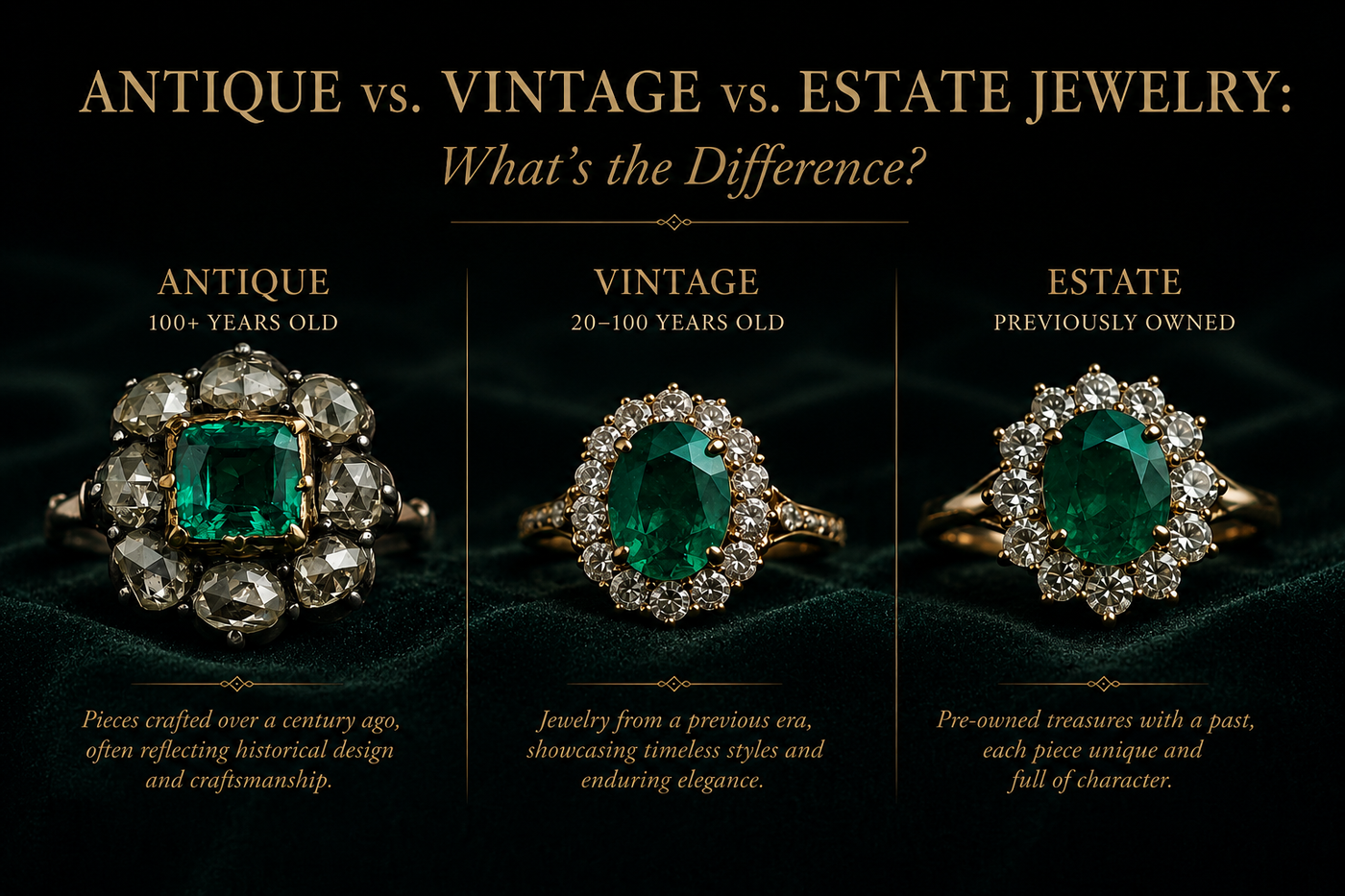
Three words get used as if they mean the same thing. They don't. And the difference between them changes what a piece is worth, how it should be priced, and whether the person selling it to you actually knows what they have.
Here's the honest breakdown, the way people inside the trade actually use these terms.
Antique: older than 100 years
Antique is the only one of the three with a hard, agreed-upon line. A piece has to be over a century old to earn the word. Today that means anything made before the mid-1920s — the Georgian, Victorian, Edwardian, and earliest Art Deco eras. These pieces get rarer every year by definition, are often handmade in ways that are no longer economical to reproduce, and frequently carry history you can trace. Antique is not a mood. It's an age.
Vintage: roughly 20 to 100 years old
Vintage is the middle ground — older than about 20 years, but not yet antique. In practice that spans the Retro glamour of the 1940s, the clean confidence of mid-century design, the bold statements of the 1970s and 80s. "Vintage" tells you a piece has an era and a point of view, not that it's a century old. This is where the term gets stretched the most: plenty of things are called vintage that are barely old enough to vote.
Estate: previously owned, at any age
Estate is the one people misunderstand most. It says nothing about age. It simply means the piece has had a previous owner. An Edwardian ring from 1905 is estate. A bracelet bought three years ago is also estate. Estate is about ownership, not time — it's the trade's polite word for pre-owned.
Why the categories overlap
They aren't mutually exclusive, which is exactly why the terms blur. That 1905 Edwardian ring is antique and estate at once. A 1980s gold chain is vintage and estate. A piece can wear two of these labels honestly. The problem is only when someone reaches for the most flattering one to imply something that isn't true.
Why this matters before you buy
Because the label should match the price. "Antique" carries a premium — so if something is priced as antique, it should be able to prove its age through style, construction, and ideally a hallmark. "Estate" on its own tells you nothing about value; a piece can be estate and completely ordinary. When a seller reaches for the grandest term that technically applies, that's your cue to ask more questions, not fewer.
The right question is never just "how old is it." It's "how do you know." A dealer who can answer that — era, origin, what the marks mean, why it was made the way it was — is a dealer worth buying from.
That's the standard every piece at ZHIVA is held to before it's offered. Not the most flattering word. The true one.
Looking for a specific piece, or something made just for you? We can source it on your behalf or design a bespoke commission.
— Sasha, ZHIVA
One of One
Now go find yours.
Every ZHIVA piece is antique, vintage, or built from the stone up — and there is only ever one of each.
Keep Reading

Signet Rings: From Seal to Style
The signet ring is the oldest ring with a job. It was a signature, and the test of...
Read more
Cocktail Rings: The Statement Ring With a Prohibition Backstory
The cocktail ring was designed to be seen holding a glass you were not legally allowed to hold....
Read more
Three-Stone Rings: The History, the Marketing, and How to Choose One
The past, present and future story is 1990s advertising, not history. Three-stone rings are far older and far...
Read more