August 04, 2026
Gemstone Hardness: What the Mohs Scale Means for Jewelry You Actually Wear
Filed under Antique & Vintage Engagement RingsGemstone GuidesBuying GuidesCare, Sizing & Insurance
You've fallen for a stone and the real question is simple: will it hold up if you wear it every day, or will it end up scratched and sad in a year? Gemstone hardness is how you answer that before you buy, and the Mohs scale is the shorthand the whole trade uses.
What the Mohs scale actually measures
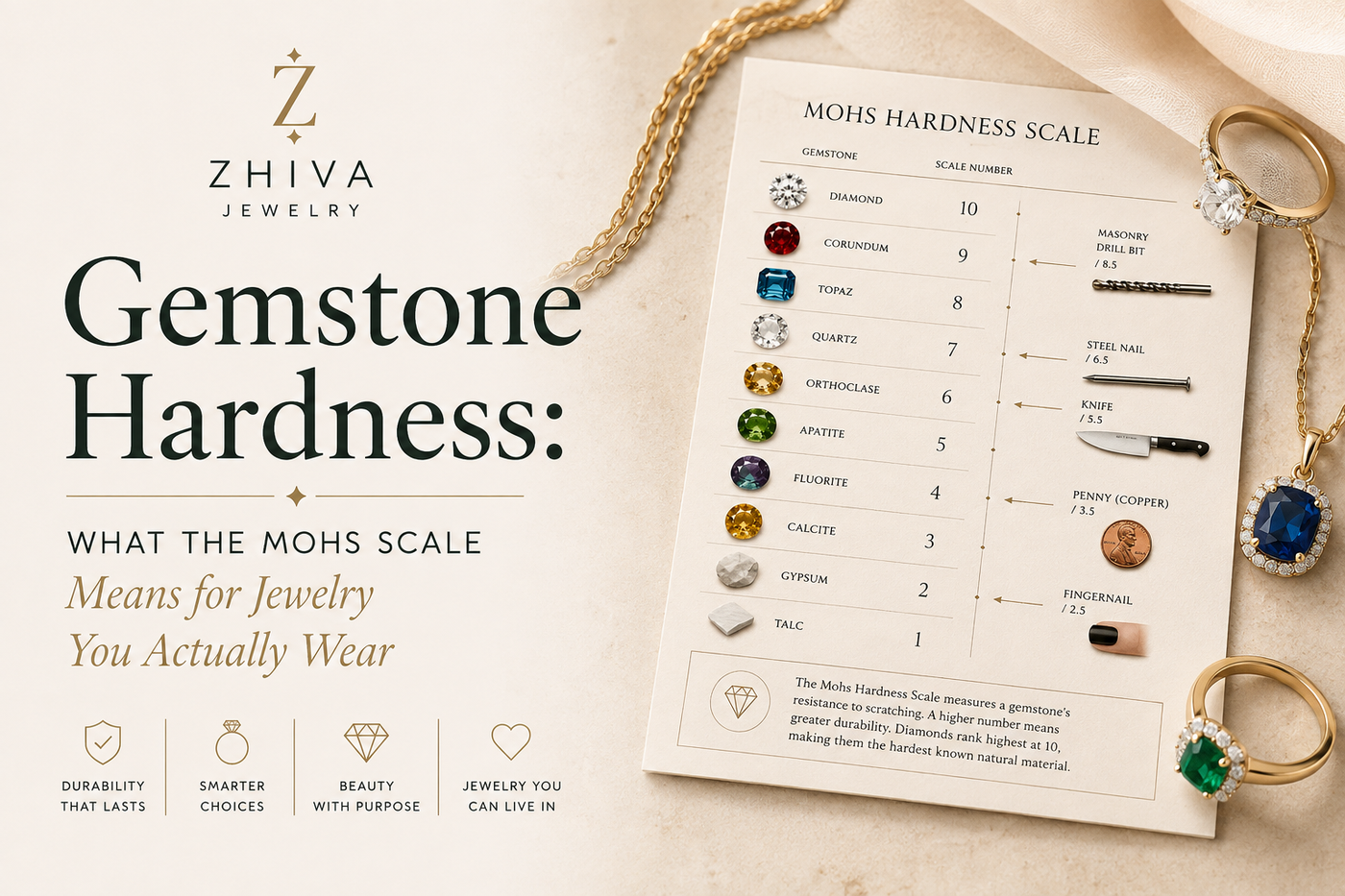
The Mohs scale ranks a mineral's resistance to scratching, from talc at 1 to diamond at 10. Each stone can scratch anything softer than itself and be scratched by anything harder. Diamond sits at 10, corundum — that's both ruby and sapphire — at 9, topaz at 8, quartz at 7. It's an ordinal ranking, not a linear one: the jump from 9 to 10 is enormous, and diamond is many times harder than the sapphire one step below it. So a number tells you the order, not the true distance between stones.
Hardness isn't toughness — and the difference matters
This is where most people get burned. Hardness resists scratching. Toughness resists chipping and breaking, and they are not the same property. Diamond is the hardest natural material on earth, yet it has cleavage planes and can split from a sharp knock at the wrong angle. Emerald scores a respectable 7.5 to 8 but is riddled with inclusions and fractures, so it chips more easily than its number suggests. Jade is the opposite story — only 6 to 7 on Mohs, but so tough it was carved into axe heads. Read both traits before you decide a stone is safe for daily wear.
The number 7 is the line for daily wear
Household dust contains fine quartz particles, which sit at 7. That means anything softer than quartz gets slowly abraded just by being wiped, handled, and knocked against countertops over the years. This is why 7 is the practical threshold for a ring you never take off. Above it, a stone shrugs off ordinary life. Below it, you're accepting that the surface will soften and lose polish over time — fine for some pieces, a slow heartbreak for others.
Best stones for a ring you wear every day
For an engagement ring or an everyday band, stay at 8 and above where you can. Diamond (10) is the obvious choice and the reason it became the engagement standard. Sapphire and ruby (9) are the smartest colored-stone options for hard wear, which is exactly why antique sapphire rings survive a century of use. Spinel and topaz (8) hold up well too. If you're weighing stones, our guide on how to tell if a gemstone is fine covers what separates a durable stone from a fragile one, and choosing a vintage engagement ring gets into settings that protect the center.
Softer stones — and how to wear them anyway
A stone under 7 isn't off-limits; it just belongs somewhere protected. Opal (around 5.5 to 6.5) contains water and can craze if it dries or takes a hit. Pearl (2.5 to 4.5) is soft enough to scratch with a fingernail. Tanzanite (about 6.5) has cleavage and dislikes knocks. Emerald, moonstone, turquoise, and peridot all reward gentle handling. Put these in earrings, pendants, and brooches, where they face almost no impact, and they'll outlive you. If you love a softer stone in a ring, a bezel setting shields the girdle and edges — the kind of problem worth solving in a bespoke design rather than forcing it into a fragile prong setting.
A quick hardness reference
Diamond 10. Ruby and sapphire 9. Topaz and spinel 8. Emerald, aquamarine, and beryl 7.5 to 8. Quartz — amethyst, citrine — 7. Garnet 6.5 to 7.5. Peridot and tanzanite around 6.5. Moonstone and other feldspars 6 to 6.5. Opal and turquoise 5 to 6.5. Lapis 5 to 6. Pearl 2.5 to 4.5. The Mohs scale is standard enough that the GIA publishes it as a reference for exactly this reason.
What wear tells you when buying antique
With estate pieces, hardness explains what you're looking at under a loupe. Soft stones in old rings often show rounded facet edges and worn polish — normal for their age, not a defect, but it should be reflected in the price. A hundred-year-old sapphire, by contrast, can look nearly untouched. Signs of abrasion on a stone that should be hard are a red flag worth questioning. When you understand the scale, condition stops being a mystery and becomes evidence.
— Sasha, ZHIVA
One of One
Now go find yours.
Every ZHIVA piece is antique, vintage, or built from the stone up — and there is only ever one of each.
Keep Reading

What $3,000, $5,000 and $10,000 Buys in an Antique Engagement Ring
An honest guide to antique engagement ring cost: the realistic trade-offs at $3,000, $5,000 and $10,000, where value...
Read more
Old European Cut Diamonds: What Actually Drives the Price
Old European cut diamonds do not price like modern rounds. How carat thresholds, spread, warm colour, recutting and...
Read more
Designing a Ring Around an Inherited Diamond
Resetting an inherited stone is the most emotionally loaded work in jewelry, and the technical decisions get made...
Read more