July 31, 2026
How to Choose a Vintage or Antique Engagement Ring: A Collector's Guide
Filed under Antique & Vintage Engagement RingsBuying Guides
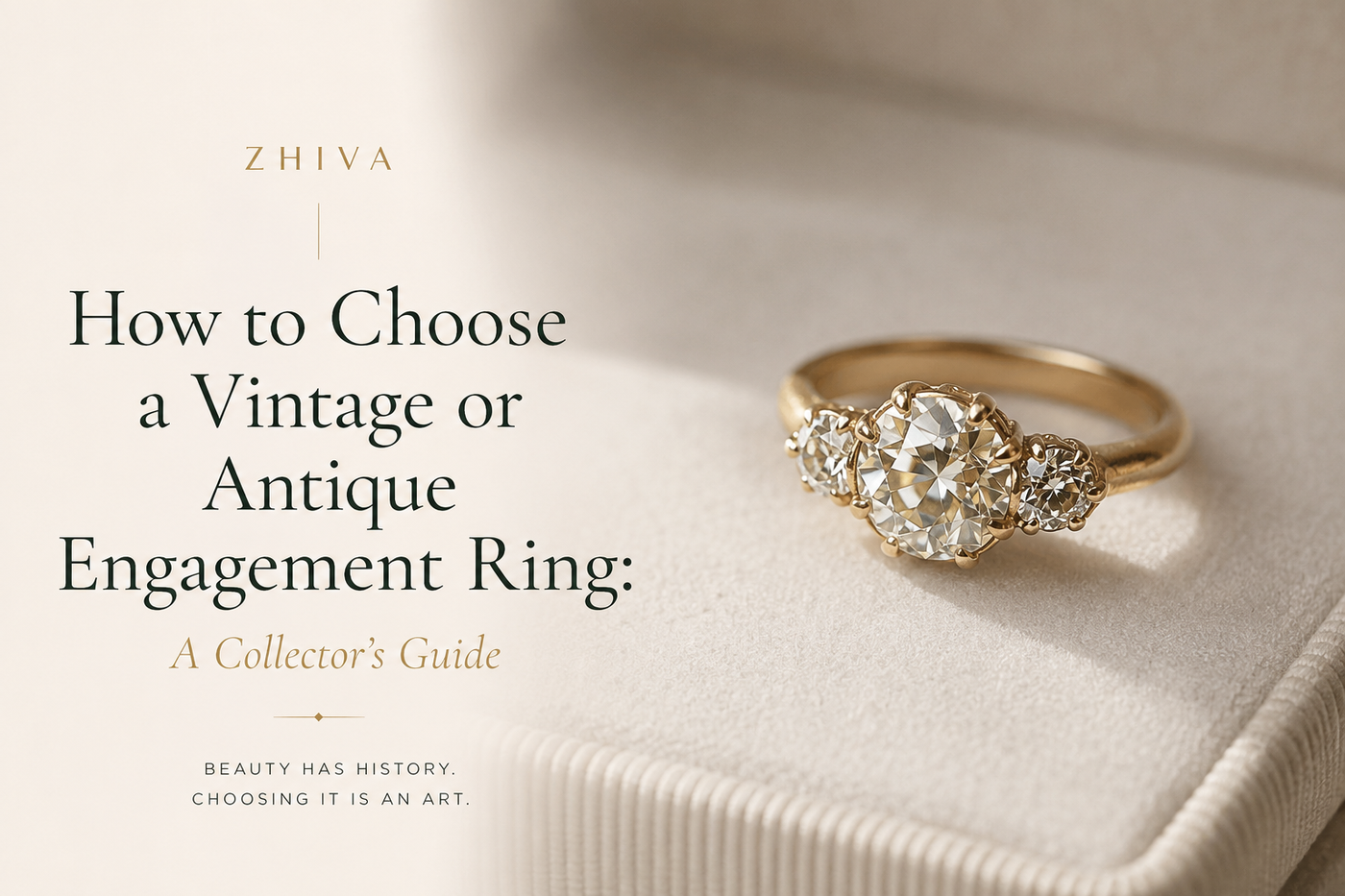
A vintage engagement ring is a different kind of decision than a new one. You're not just choosing a design — you're choosing a piece that already has a history, and taking on the job of judging whether that history is real and whether the ring will last another lifetime. Here's how to do it well.
Start with the era, not the stone
Every antique and vintage engagement ring speaks in the language of its era, and learning that language is the first real step. Edwardian rings (1901–1915) are delicate platinum filigree, milgrain, and garlands. Art Deco (1915–1935) is geometric, bold, architectural, often with colored-stone accents. Victorian rings run romantic and warm in yellow gold. Knowing the eras tells you what's plausible — a ring described as Art Deco but built in a style that didn't exist until the 1950s is telling you something. If you want the full breakdown, start with the difference between antique, vintage, and estate.
Understand antique diamond cuts
This is where vintage rings win. Old European and old mine cuts were shaped by hand, before electric cutting, with higher crowns and smaller tables that throw a softer, warmer light than today's machine-perfect brilliants. Rose cuts, older still, glow rather than sparkle. None of this is a flaw — for most collectors it's the entire appeal, and these cuts are surging back in 2026. But cut also drives value and beauty, so learn what a good example looks like. The GIA's guide to cut is a solid primer on why proportion matters.
Judge the stone honestly
An old ring with a mediocre stone is still a mediocre stone. Color, cut, clarity, and whether a colored stone has been treated all decide what you're really paying for. A center stone that's been replaced with a modern one changes both the character and the value of an antique ring — not always a dealbreaker, but always something you should know before you buy. We walk through the whole judgment in how to tell if a gemstone is fine.
Check the setting and the condition
A hundred years of wear leaves marks. Look for a worn-thin shank, cracks near the stones, replaced prongs, and heavy old solder repairs. Original, honest condition commands a premium for a reason — it's rarer and it lasts. And turn the ring over: the tiny stamps inside the band can confirm metal, maker, and often the era. Reading them is a skill worth having, and we cover it in how to read a hallmark.
Verify before you fall in love
The right question is never just "how old is it" — it's "how do you know." A trustworthy seller can support an age with construction, wear, hallmarks, and provenance, and will tell you plainly about any repairs or replaced stones. If the answers get vague, that's your answer. Remember too that an antique ring is often more of a long-term store of value than a new one — more on that in is antique jewelry a good investment.
Antique, or antique-style?
Be clear on which you want. A genuine antique ring carries real history and often holds value better. An antique-style ring is newly made to look old — sometimes the smarter choice if you want a specific size, a durable everyday stone, or a design that doesn't quite exist in the originals. Neither is wrong. They're just different, and they should be priced differently.
Buy from someone who'll tell you the truth
The best thing you can bring to this is a person who knows more than you do and has no reason to oversell. If you're hunting a particular era or stone, a private sourcing service can find and verify it for you. And if the ring in your head doesn't exist yet, a bespoke design — sometimes built around an antique stone — can make it. Either way, the ring you end up wearing for the rest of your life should be one someone stood behind.
— Sasha, ZHIVA
One of One
Now go find yours.
Every ZHIVA piece is antique, vintage, or built from the stone up — and there is only ever one of each.
Keep Reading

What $3,000, $5,000 and $10,000 Buys in an Antique Engagement Ring
An honest guide to antique engagement ring cost: the realistic trade-offs at $3,000, $5,000 and $10,000, where value...
Read more
Old European Cut Diamonds: What Actually Drives the Price
Old European cut diamonds do not price like modern rounds. How carat thresholds, spread, warm colour, recutting and...
Read more
Designing a Ring Around an Inherited Diamond
Resetting an inherited stone is the most emotionally loaded work in jewelry, and the technical decisions get made...
Read more