August 01, 2026
Old European vs. Old Mine Cut Diamonds: How Antique Cuts Compare to the Modern Brilliant
Filed under Antique Diamonds & Diamond CutsAntique & Vintage Engagement Rings
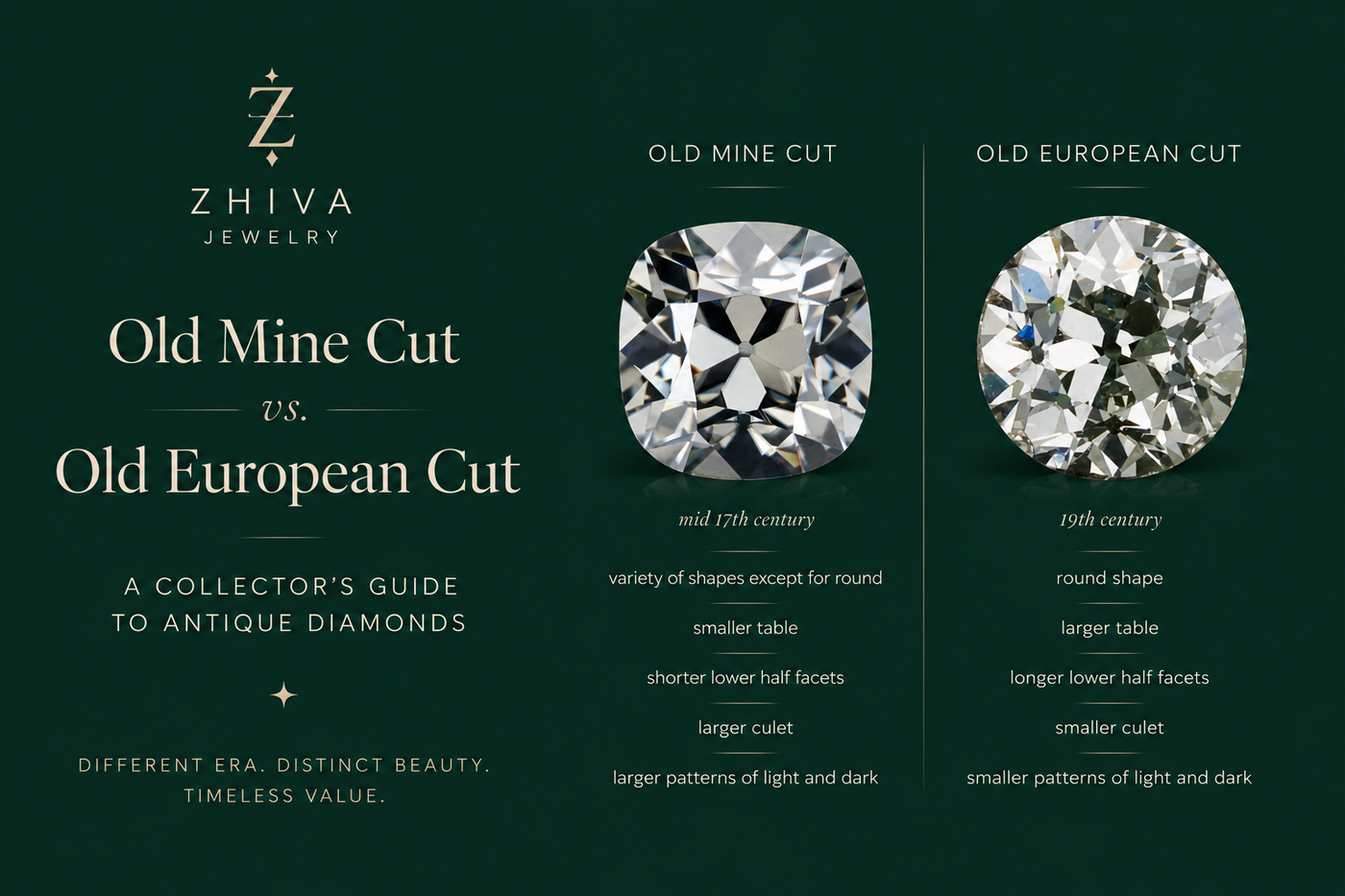
If you're shopping for an antique ring, you'll keep running into two terms — old European cut and old mine cut — often described as if they're interchangeable. They aren't. They're different stones from different centuries, cut by hand for candlelight, and they behave nothing like the modern round brilliant most people picture when they think "diamond." Here's how to tell them apart and decide which one you actually want.
Why antique diamond cuts look different in the first place
A modern round brilliant is engineered. Its 57 or 58 facets are cut to mathematically optimized angles that maximize brightness and fire under electric light, and machines do most of the work. Antique cuts predate all of that. They were shaped by hand, by eye, to glow under candlelight and gaslight — the light people actually lived by. That's why an old cut can look sleepy under a jeweler's spotlight and then come alive across a dinner table. It was designed for the second room, not the first.
The old mine cut: the older, chunkier stone
The old mine cut is the earlier of the two, dominant from the 1700s through the mid-1800s. Look for a squarish, cushion-like outline with soft corners, a high crown, a small flat table, a deep pavilion, and — the giveaway — a large open culet, the flat facet at the bottom that reads as a little window or dark circle when you look straight down through the stone.
Old mine cuts were shaped to follow the rough diamond crystal and waste as little as possible, so no two are truly identical. Their sparkle is broad and blocky — big flashes rather than a fine shimmer. If you want a stone that looks unmistakably hand-made and old, this is it.
The old European cut: rounder, and the bridge to modern
By the 1870s, the introduction of the bruting machine let cutters make diamonds properly round, and the old European cut arrived. It keeps the antique DNA — high crown, small table, open culet, deep pavilion — but in a circular outline. The old European cut diamond is the direct ancestor of today's round brilliant, and it's the antique cut most people fall for: rounder than an old mine, but still full of that soft, chunky, candlelit fire.
The open culet is again your best clue. Look down through the table and you'll usually see that small window at the bottom, plus larger, fewer facets than a modern stone. The effect is warmer and more romantic — less disco-ball, more glow.
How they compare to the modern round brilliant
Set the three side by side and the differences are clear. The modern brilliant is bright, white, and precise, cut to return maximum light straight up at you. The old European is warmer and softer, with bigger flashes of fire. The old mine is the most characterful — irregular, blocky, and obviously cut by a person.
There's a practical trade-off too. Antique cuts were graded by eye centuries before the GIA existed, so they often carry more warmth in color and more visible inclusions than a modern lab report would flag. To an antique buyer that isn't a flaw — it's the point. You're buying character and history, not spec-sheet perfection. If you want to sharpen your eye on that distinction, our guide to telling whether a gemstone is fine is a good next read.
Why antique cuts are back
For two decades, the market rewarded whiteness and precision. That's turning. Buyers now want a stone with a story and a look that isn't identical to everyone else's — and old cuts deliver both. They're increasingly hard to find, because most were re-cut into modern brilliants during the 20th century, which makes the survivors genuinely scarce. A well-preserved old European or old mine cut is a finite resource, and the market has noticed.
How to buy one without getting burned
Ask three questions. Is it an original antique cut, or a modern stone cut to look old? (Both exist; "old European cut" on a listing doesn't guarantee age.) Does it have an open culet and hand-cut irregularity, or the clean symmetry of a machine? And is there a lab report — from the GIA or another respected lab — describing the cut and any treatments?
See the stone in warm light, not just under a spotlight, because that's where an old cut is meant to perform. If you're weighing an antique cut for an engagement ring specifically, our guide to choosing a vintage or antique engagement ring walks through setting, condition, and fit. And if you're just getting started, how to start a collection without getting burned covers the fundamentals.
When you're ready to look at real stones, our collection is where to start — or we can source a specific cut for you.
— Sasha, ZHIVA
One of One
Now go find yours.
Every ZHIVA piece is antique, vintage, or built from the stone up — and there is only ever one of each.
Keep Reading

Old European Cut Diamonds: What Actually Drives the Price
Old European cut diamonds do not price like modern rounds. How carat thresholds, spread, warm colour, recutting and...
Read more
Designing a Ring Around an Inherited Diamond
Resetting an inherited stone is the most emotionally loaded work in jewelry, and the technical decisions get made...
Read more
How to Read a Diamond Report on an Antique Stone
Grading reports were designed for modern round brilliants, and on an antique stone half the document is misleading....
Read more