July 29, 2026
How to Tell If a Gemstone Is Fine: A Collector's Field Guide
Filed under Antique Diamonds & Diamond CutsGemstone GuidesBuying Guides
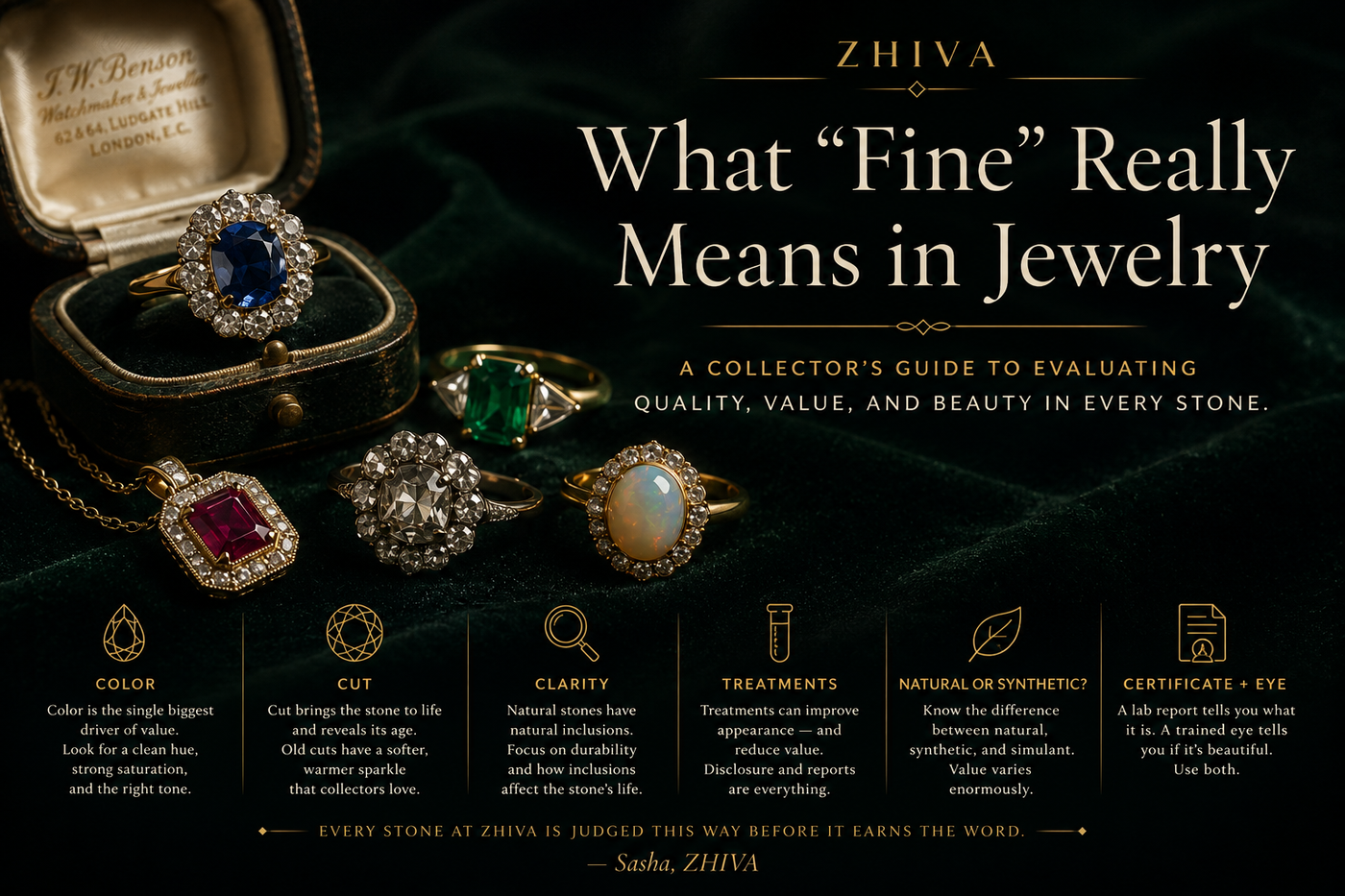
"Fine" is one of the most abused words in jewelry. It doesn't mean old, and it doesn't mean expensive. It means the material itself — the stone, the metal — is of genuine quality. A hundred-year-old ring set with a mediocre stone is still an old ring with a mediocre stone. Here's how to tell the difference.
Color does most of the work
For colored stones, color is the single biggest driver of value — more than size. What you're judging is hue (is it a clean, true color or muddied toward brown or gray?), saturation (how vivid), and tone (not so dark it goes black, not so pale it goes weak). A smaller stone with superb color beats a large one that's washed out. Train your eye by looking at a lot of stones side by side; quality becomes obvious once you've seen the real thing.
Cut is where beauty lives
Cut is what makes a stone come alive under light, and in antique jewelry it's also a clue to age. Old European and old mine cuts, cut by hand before modern machinery, have a softer, warmer sparkle than today's precise brilliants. That's not a flaw — for many collectors it's the entire appeal. But cut also affects value: a well-proportioned stone returns light evenly, while a poorly cut one goes dark or glassy in the center.
Clarity, in context
Clarity is about the inclusions inside a stone. Cleaner is generally more valuable, but perspective matters: natural stones have natural characteristics, and in antique pieces a few inclusions are normal and no cause for alarm. What you're watching for is inclusions bad enough to threaten durability or dull the stone's life. A flawless-looking colored stone at a suspiciously low price is a reason to ask more, not less.
Treatments are the thing most people miss
This is where value quietly disappears. Many stones on the market are treated to improve appearance — heat, glass-filling, dyeing, irradiation. Some treatments are common and accepted; others sharply reduce value and durability. The point isn't that treated stones are worthless. It's that they should be disclosed and priced accordingly. An untreated stone of good natural color is worth far more than a treated one that looks similar, and only testing or a report can tell them apart with certainty.
Natural, synthetic, or simulant
A natural stone formed in the earth. A synthetic has the same chemistry but was grown in a lab. A simulant just looks the part (like glass or cubic zirconia standing in for diamond). All three can appear in old settings — synthetics have existed for over a century. Value differs enormously between them, so this is a question worth asking directly.
When to trust a certificate — and when to trust your eye
For significant stones, an independent report from a respected lab is worth its cost; it settles identity, and often treatment. But a certificate describes a stone, it doesn't fall in love for you. The best approach is both: the paper for what can be measured, and a trained eye — yours or someone you trust — for whether the stone is actually beautiful. Fine is measurable and visible at once.
Every stone at ZHIVA is judged this way before it earns the word. It's the same eye we bring to sourcing a fine stone for you or setting one in a bespoke design.
— Sasha, ZHIVA
One of One
Now go find yours.
Every ZHIVA piece is antique, vintage, or built from the stone up — and there is only ever one of each.
Keep Reading

Old European Cut Diamonds: What Actually Drives the Price
Old European cut diamonds do not price like modern rounds. How carat thresholds, spread, warm colour, recutting and...
Read more
Designing a Ring Around an Inherited Diamond
Resetting an inherited stone is the most emotionally loaded work in jewelry, and the technical decisions get made...
Read more
How to Read a Diamond Report on an Antique Stone
Grading reports were designed for modern round brilliants, and on an antique stone half the document is misleading....
Read more