August 05, 2026
Common Gemstone Treatments: What's Accepted, What Kills Value
Filed under Gemstone GuidesBuying Guides
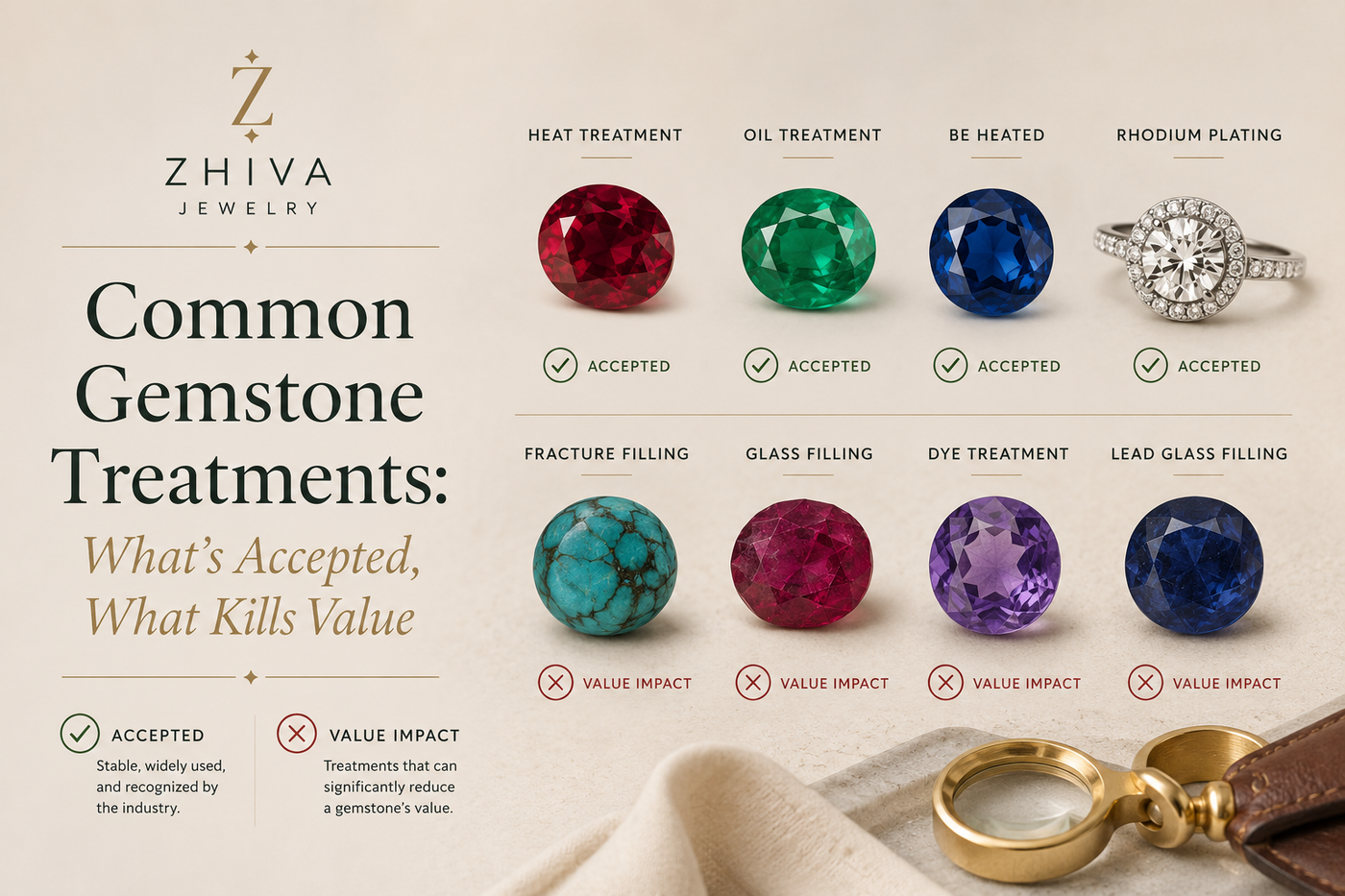
Almost every colored stone on the market has been touched by something other than the earth. The real question isn't whether a gemstone is treated — most are — it's which treatments are normal, which ones you're paying a premium to avoid, and which quietly gut a stone's value. Here's how to tell them apart.
Why gemstone treatments exist at all
Nature makes very few stones that are saturated, clean, and durable straight out of the ground. For centuries the trade has used gemstone treatments to coax color and clarity out of rough that would otherwise be dull or fractured. Some of these methods are ancient and fully accepted; others are modern shortcuts that make a stone look far better than it will ever be worth. The difference matters because two rubies that look identical in a shop window can be separated by a factor of ten in price based on treatment alone. Knowing the categories is the same skill as learning how to tell if a gemstone is fine in the first place.
Heat: the treatment nobody minds
Heating is the most common and most accepted treatment in the trade. Controlled heat improves the color and clarity of sapphire, ruby, tanzanite, aquamarine, and citrine, and the change is permanent and stable. A heated sapphire is a legitimate, ordinary stone — not a compromised one. Most citrine, including much of what turns up in antique garnet, amethyst and citrine jewelry, is heated amethyst, and nobody sensible holds that against it.
The premium sits at the other end: unheated stones with strong natural color are rare, and a lab report confirming "no indications of heating" can multiply the price of a fine sapphire or ruby. So heat itself doesn't kill value — but paying an unheated premium for a stone that was actually heated does. That's a paperwork problem, not a stone problem, and it's why a report from a respected lab earns its keep.
Fracture-filling and glass-filling: read the fine print
This is where buyers get hurt. Emeralds are almost universally treated with oil or resin to fill their natural fissures and improve clarity — a practice so old it's expected, and minor oiling is accepted as long as it's disclosed. Heavy resin, though, hides serious fractures and can leak or cloud over time.
Glass-filled ruby is a different animal
Lead-glass-filled ruby (often sold as "composite ruby") is corundum so fractured it would be worthless on its own, flooded with molten glass to hold it together and fake transparency. It can crack from a jeweler's torch, a hot ultrasonic, even lemon juice. It is not a fine ruby, and it should never carry a fine ruby's price. If a "ruby" seems suspiciously cheap for its size and color, this is usually why.
Dyeing, coating, and diffusion
Dyeing pushes color into porous stones — think low-grade jade, some agate, and dyed "black onyx." It's acceptable in inexpensive material when disclosed, but the color can fade or bleed. Coating paints color onto the surface (mystic topaz is the honest, obvious version); it scratches off and belongs only in costume-priced pieces. Diffusion is more insidious: heat and chemicals force color into the outer skin of a sapphire, so a re-cut or chipped stone can reveal a pale, colorless interior. Any of these can be fine at the right price — the fraud is selling them as untreated natural color.
Irradiation and the case of blue topaz
Irradiation followed by heat is how nearly all blue topaz gets its color, and it's stable and safe to wear. It also produces some colored diamonds. The treatment is accepted, but it must be disclosed, because an irradiated blue diamond is worth a fraction of a naturally colored one. As with heat, the treatment isn't the problem — the silence around it is.
What treatments mean for durability and care
Treatment isn't only a value question; it changes how you live with a stone. Oiled emeralds and glass-filled rubies must never see an ultrasonic cleaner or a steamer. Coated and diffused stones can't survive a re-polish. This is one more reason a stone's hardness and everyday wearability should be weighed alongside how it was treated before you commit — especially in a ring, which takes the most abuse.
Disclosure is the whole ballgame
Here's the honest rule: a treatment is only a problem when it's hidden or mispriced. A reputable seller tells you exactly what was done, prices the stone accordingly, and backs significant claims — unheated, no oil, natural color — with a report from an independent lab. GIA's gem treatment reference and its gemological research are the standard the trade measures against, and worth reading before you buy anything expensive. The same disclosure logic governs the natural versus lab-grown diamond conversation: what a stone is matters far less than whether you were told the truth about it.
If you want a specific stone vetted before money changes hands, that's exactly what our sourcing service is for — we chase down the report and the treatment history so you don't inherit someone else's guesswork.
— Sasha, ZHIVA
One of One
Now go find yours.
Every ZHIVA piece is antique, vintage, or built from the stone up — and there is only ever one of each.
Keep Reading

Garnet, Amethyst and Citrine: The Underrated Antique Stones
Amethyst was once priced with emerald. Then Brazil happened. The stones that lost their value to supply are...
Read more
Natural vs Cultured Pearls in Antique Jewelry: Why the Difference Is Enormous
Before the 1920s every pearl in jewelry was natural, and natural pearls frequently cost more than the diamonds...
Read more
Cocktail Rings: The Statement Ring With a Prohibition Backstory
The cocktail ring was designed to be seen holding a glass you were not legally allowed to hold....
Read more