August 06, 2026
Heirloom Redesign: How to Turn Inherited Jewelry Into Something You'll Actually Wear
Filed under Heirlooms & Bespoke Design
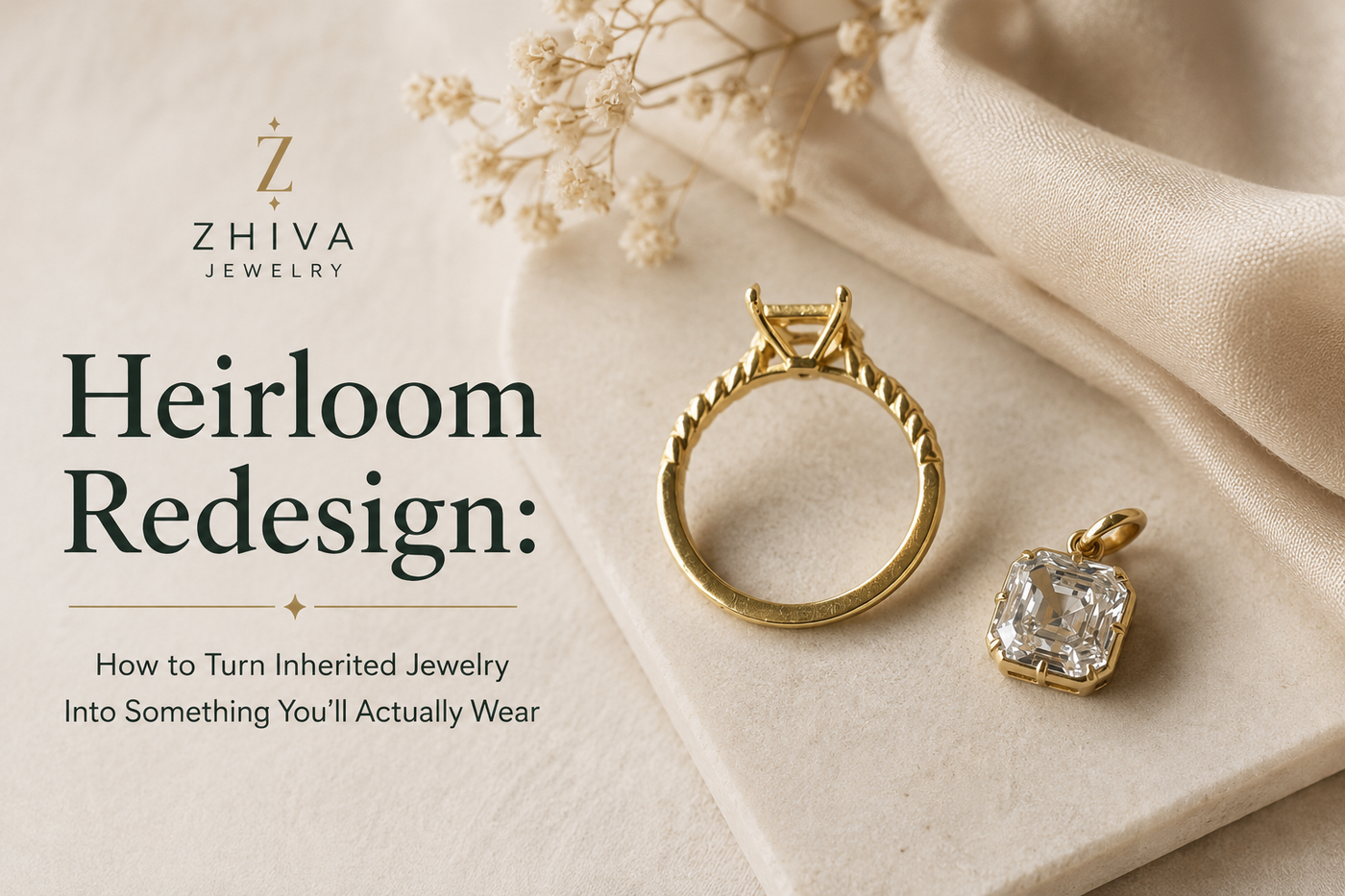
You inherited a ring, a brooch, a pair of earrings — something that mattered to someone you loved. It sits in a drawer. You want to wear it, but the style isn't yours, the size is wrong, or it's too fragile to touch. The real question isn't whether to redesign an heirloom. It's how to do it without erasing what made the piece worth keeping.
Start by knowing what you actually have
Before anyone touches a stone, get the piece identified. A heavy Victorian brooch and a 1970s reproduction look similar in a drawer and are worth wildly different things. Have a jeweler or independent appraiser confirm the metal, the era, and whether the stones are what they appear to be. The GIA can grade loose diamonds and colored stones, which matters if a center stone is the reason you're keeping the piece at all. If there are marks inside the band or on the back, learning to read the hallmark tells you the metal, sometimes the maker, and often the exact year.
This step decides everything after it. A signed piece by a known house, or an intact early setting, may be worth more left alone than remade.
Decide what to keep and what to let go
Most heirlooms are worth saving in part, not in whole. The emotional weight usually lives in one element — a grandmother's diamond, an engraved date, a specific color of gold. Name that element first. Everything else is negotiable.
A worn, thin band with no maker's mark is a candidate for melting or replacing. A hand-cut old European diamond is not — its faceting can't be reproduced, and recutting it destroys carat weight and character. If the value or the meaning sits in a fine gemstone, build the new design around keeping that stone whole and untouched.
The three honest redesign paths
Nearly every heirloom project falls into one of three approaches, in order of how much survives.
Reset the stone
The least invasive route. You lift the original stone from a tired or broken mount and set it into a new one built to your hand and your taste. The stone — the part that carries the story — is untouched. This is the right answer when the setting has failed but the center is sound.
Rebuild around original elements
Here you keep more than one component: two stones from a pair of earrings become a two-stone ring, or a cluster of small diamonds from a brooch is scattered across a new band. If you like the idea of pairing an inherited stone with a second, a toi et moi setting is a natural way to combine an heirloom diamond with one you choose yourself.
Reuse the material only
When the piece is broken beyond saving or was never fine to begin with, its gold still has value. Melting inherited metal into a new piece keeps a literal, physical thread to the original — the same gold, a new form. It's the most freeing option and the one that leaves the least of the original design intact. Be honest with yourself about that trade.
What redesign can't fix
Redesign is not restoration, and it isn't magic. It can't make a low-quality stone look like a fine one. It can't recreate the exact hand of a nineteenth-century workshop in a modern setting — the result will be inspired by the era, not of it. And it permanently ends the piece's life as an antique. Once you reset a stone, the original object is gone. If part of you suspects you'd regret that, wait. A drawer is cheaper than a decision you can't reverse.
How the process actually works
A good redesign starts with a conversation, not a sketch. You bring the piece, we identify it, and we talk about what the new object needs to do — daily wear, occasion, everyday size and comfort. From there come drawings, then a wax or digital model you approve before any stone is moved. Nothing is cut, reset, or melted until you've seen and signed off on the final design. If you're weighing what's possible with a specific inherited piece, our bespoke design process is built around exactly this: keeping what matters and rebuilding the rest. If the piece is headed toward an engagement ring, it's worth reading how to choose a vintage engagement ring before you commit to a direction.
The best heirloom redesign doesn't look like a compromise. It looks like something you'd have chosen anyway — that happens to carry a stone someone once chose for you.
— Sasha, ZHIVA
One of One
Now go find yours.
Every ZHIVA piece is antique, vintage, or built from the stone up — and there is only ever one of each.
Keep Reading

Sourcing: How a Specific Antique Ring Actually Gets Found
You know exactly what you want and it is not for sale anywhere. Sourcing is the work of...
Read more
Designing a Ring Around an Inherited Diamond
Resetting an inherited stone is the most emotionally loaded work in jewelry, and the technical decisions get made...
Read more
Wear What Survived: The Story of ZHIVA
Years inside the fine antique and estate jewelry world teach you what's truly fine — and what to...
Read more